

The AI industry in India has become louder than ever. Every second LinkedIn profile now mentions AI. Institutes promise to turn beginners into “AI Engineers” in a few months. YouTube is flooded with tutorials on ChatGPT, AI agents, and prompt engineering.
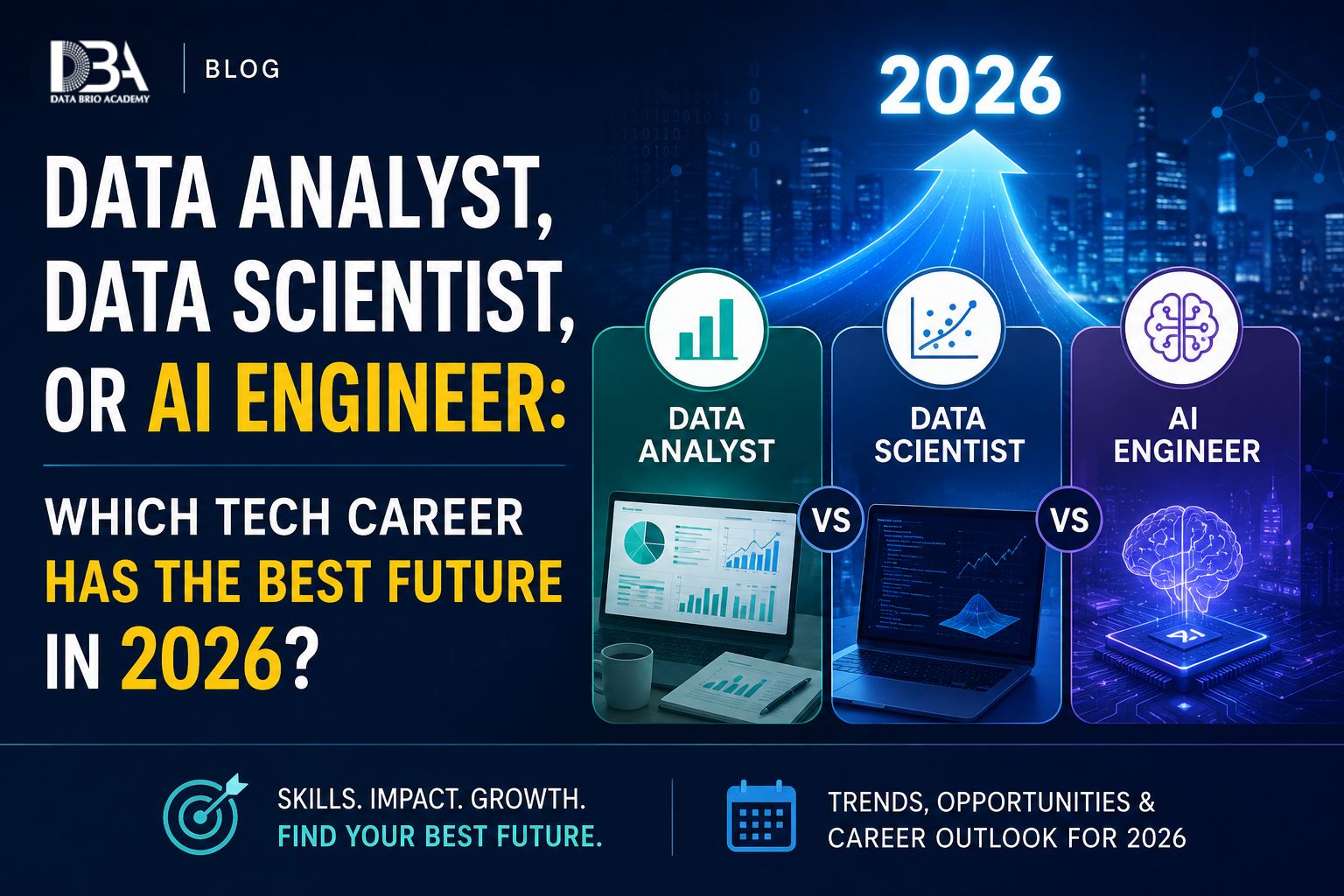
But beneath all the hype, one question continues to confuse students and working professionals alike: Should you become a Data Analyst, Data Scientist, or AI Engineer in 2026?
And more importantly: Which role actually makes sense for your background, skills, and long-term career goals?
The Indian hiring market has evolved rapidly over the last two years. Companies are moving away from generic “data science” hiring and increasingly looking for role-specific practical skills. At the same time, Generative AI has changed what employers expect from candidates entering the industry. This means choosing the right path early matters more than ever.
And here’s a reality most aspirants don’t hear enough: For many beginners, becoming a strong Data Analyst first is actually the smartest route into AI and Data Science careers.
This article breaks down:
- The real difference between Data Analysts, Data Scientists, and AI Engineers
- Career growth opportunities in India
- Required skills
- Hiring trends in 2026
- Which role suits different types of learners
- How Gen AI is changing all three careers
If you’re trying to build a future-proof AI career in India, this guide will help you think beyond hype.
What Does a Data Analyst, Data Scientist, and AI Engineer Actually Do?
Before comparing growth opportunities, let’s simplify the roles.
What Does a Data Analyst Do?
A Data Analyst works with business data to uncover trends, insights, and operational patterns. Typical responsibilities include:
- Cleaning and organizing data
- Building dashboards
- Creating business reports
- Analysing performance metrics
- Supporting decision-making teams
Common Tools Used by a data analyst –
Excel, SQL, Power BI/Tableau, Python (basic to intermediate) etc.
Real-World Example
A retail company wants to understand why sales dropped during a festive campaign in Kolkata. A Data Analyst studies customer behaviour, sales trends, campaign performance, and regional purchase patterns to identify what went wrong. If you want to understand how visualization and reporting work in real analytics environments, refer When to Use Which Chart for Data Visualization and Analytics
What Does a Data Scientist Do?
A Data Scientist focuses more on prediction, modelling, and machine learning.
Their work usually involves:
- Building and operationalizing ML models
- Performing statistical analysis
- Creating predictive systems
- Working with large datasets
- Solving complex business problems
Common Tools used by a data scientist –
Python, SQL, Statistics, Machine Learning libraries, Scikit-learn, TensorFlow, Azure etc.
Real-World Example
An e-commerce company wants to predict which customers are likely to stop purchasing next month. A Data Scientist builds a churn prediction model using historical user behaviour data.
But one important shift in 2026 is that companies increasingly expect Data Scientists to understand AI implementation and business outcomes — not just algorithms. So they need to work not only on developing models but also operationalizing the models and also monitoring it in production in many cases.
What Does an AI Engineer Do?
An AI Engineer focuses on building and deploying AI-powered systems into real applications. In 2026, this role increasingly includes:
- Building Gen AI applications
- Working with LLM APIs
- RAG pipelines
- AI agents
- AI workflow automation
- Model deployment
Common Tools used by an AI engineer –
- Python, LangChain, LlamaIndex, Computer vision models, Vector databases, APIs, Azure/OpenAI integrations
Real-World Example
A fintech startup wants an AI-powered customer support assistant connected to internal company documents. An AI Engineer builds a Retrieval-Augmented Generation (RAG) system using vector databases and LLM APIs. Read how to learn AI from scratch – A step by step guide for beginners for a roadmap to learn AI.
The Biggest Misconception in 2026
Many students still think:
- Data Analyst = outdated
- Data Scientist = ideal
- AI Engineer = dream role
Reality is more nuanced. Companies today increasingly prefer:
- strong analysts with business understanding,
- practical AI engineers who can deploy solutions,
- and fewer “generic” data science candidates with only theoretical ML knowledge.
The market now rewards specialization, implementation skills, and practical problem-solving. That’s a major shift from the older “everyone should become a data scientist” narrative.
Career Growth & Market Demand in India (2026)
Instead of chasing hype, it’s more useful to understand where the industry is actually growing.
| Role | Market Demand | Entry Barrier | Growth Potential | Best Suited For |
| Data Analyst | Very High | Lower | Strong | Beginners & business-focused learners |
| Data Scientist | High | Medium–High | Very Strong | Analytical & technical learners |
| AI Engineer | Exploding | Higher | Extremely High | Developers & Gen AI-focused professionals |
Why Data Analysts Still Matter More Than People Think
One of the biggest misconceptions in tech is that analytics roles are becoming obsolete because of AI. That’s not true.
AI tools can automate repetitive reporting. But businesses still desperately need professionals who:
- understand data,
- interpret business context,
- communicate insights,
- and make strategic decisions.
This is especially important in industries like Banking, Retail, Healthcare, E-commerce, and Manufacturing. For commerce graduates and non-engineers, analytics remains one of the most practical entry points into AI-driven careers. If you’re transitioning from a non-technical background into AI, Data Brio Academy offers 7 strategies for career changers without tech experience.
https://databrio.com/blog/breaking-into-ai-7-strategies-for-career-changers-without-tech-experience/
Data Science Is Evolving
A few years ago, simply learning Python and basic ML was enough to stand out but not anymore. In 2026, companies expect Data Scientists to understand:
- business impact,
- experimentation,
- deployment awareness,
- and increasingly, Generative AI workflows.
This is why many learners struggle after completing generic certifications. The industry no longer rewards “generic data science learners.” Employers increasingly hire for data science with specialized AI and analytics capabilities.
Students returning after career gaps or transitioning industries are also increasingly entering analytics and AI roles through structured practical learning instead of purely theoretical certification paths. This transition challenge is discussed in DBA’s article titled From Career Break to Data Science: How to Reboot Your Career with AI Skills.
Why AI Engineering Is Growing So Fast
AI Engineering is currently one of the fastest-growing technology roles globally. But here’s something important students misunderstand – Most AI Engineers are NOT building ChatGPT-like foundation models. Instead, they are:
- integrating APIs,
- building AI copilots,
- creating RAG applications,
- deploying AI workflows,
- and connecting AI systems to business operations.
That distinction matters because many beginners imagine AI Engineering as purely research-heavy work. In reality, most enterprise AI work today is implementation-focused. This shift is creating opportunities for developers who can combine:
- software engineering,
- AI tooling,
- cloud platforms,
- and business problem-solving.
According to a joint NASSCOM–BCG report, India’s AI market is projected to grow at a CAGR of around 25–35%, with enterprise AI adoption accelerating across banking, retail, healthcare, manufacturing, and IT services. The report also highlights that India could generate over 2.3 million AI-related job opportunities by 2027, while facing a significant talent gap in AI implementation and applied AI engineering roles.
According to McKinsey’s State of AI report, more than 65% of organizations globally are now regularly using Generative AI in at least one business function — nearly double the adoption levels seen just a year earlier. This shift is rapidly increasing demand for professionals who can:
- operationalize AI systems,
- integrate AI into workflows,
- and build practical AI applications.
Which Career Should YOU Choose?
This is the most important question. The answer depends less on hype — and more on your background, learning style and career goals.
Choose Data Analyst If You:
- Are new to coding
- Come from commerce/business backgrounds
- Want a faster entry into tech
- Enjoy visualization and storytelling
- Prefer business problem-solving
Data Analyst job is best for students or professionals with an educational background of B.Com, BSc, BBA, MBA and career switchers
Choose Data Scientist If You:
- Enjoy mathematics and statistics
- Like analytical problem-solving
- Want deeper ML expertise
- Are comfortable with Python
- Prefer predictive modelling
Data Scientist job is best for Engineering students, technical graduates and analytical learners.
Choose AI Engineer If You:
- Are excited about Gen AI
- Enjoy building applications
- Like experimenting with tools
- Want to work on cutting-edge AI systems
- Are interested in AI agents and automation
AI engineering job is best for developers, ML practitioners, software engineers, advanced AI learners.
The Smartest Career Path in 2026
Here’s the practical truth many institutes avoid discussing – Many successful AI professionals actually begin as Data Analysts. Why?
Because analytics builds business understanding, data intuition, SQL skills, visualization capabilities and problem-solving habits. Those foundations make it much easier to transition later into Data Science, ML Engineering, or AI Engineering. Trying to jump directly into advanced AI without understanding data fundamentals often creates shallow skills that recruiters identify quickly.
Even in AI Engineering roles, understanding data analytics is extremely important. AI applications are only as good as the data behind them, which makes data quality, governance, business context, and analytical thinking crucial skills for modern AI professionals.
One Important Trend Students Should Understand
The AI industry is changing rapidly. But one thing remains consistent: companies hire people who can solve business problems — not people who memorize AI buzzwords. That’s why:
- projects matter,
- implementation matters,
- communication matters,
- And business thinking matters.
This is also why many learners with dozens of certificates still struggle in interviews. This challenge is explored in this article titled “AI Hiring Challenges: Why You’re Not Getting Interviews (and How to Fix It)”
Practical Takeaways
If you’re confused between these roles, remember:
- Don’t choose a career path based only on titles or social media trends.
- In real business environments, Data Analysts, Data Scientists, and AI Engineers often work closely together as part of the same data and AI ecosystem.
- The boundaries between these roles are becoming increasingly interconnected as companies adopt AI across functions.
- Strong data understanding, business context, problem-solving ability, and communication skills are valuable across all three career paths.
- Whether you work in analytics, machine learning, or AI application development, practical implementation skills matter far more than collecting certifications.
Most importantly, the future belongs to professionals who can combine technical skills, data understanding, and business thinking to solve real-world problems with AI.
· Is Data Analyst easier than Data Scientist?
Both roles require analytical thinking and problem-solving, but the learning curve can differ depending on the skills involved. Data Analytics typically focuses more on business insights, SQL, dashboards, reporting, and data interpretation, while Data Science often involves deeper work in statistics, machine learning, predictive modelling, and programming. In practice, many professionals move across these roles over time as they build stronger technical and domain expertise.
· Is AI Engineering better than Data Science in 2026?
AI Engineering currently has momentum due to the rise of Gen AI applications and AI automation systems. However, the better role depends on your interests and technical strengths.
· Can commerce students build careers in AI?
Absolutely. Many commerce graduates begin with analytics and later transition into Data Science or AI Engineering after building stronger technical foundations.
· Is Data Science still worth learning in 2026?
Yes data science is still worth learning and data science is a good career for freshers in 2026— but employers now expect practical implementation skills, projects, and business understanding rather than just certifications.
The debate around AI Engineer vs Data Scientist vs Data Analyst is not about which role is “better.” It’s about which role aligns best with your background, your learning curve and your long-term career goals.
In 2026, the strongest careers in AI won’t belong to people chasing titles. They’ll belong to people who:
- build practical skills,
- understand data deeply,
- and adapt continuously as the industry evolves.
The good news? India’s AI ecosystem is still growing rapidly. There is space for data analysts, data scientists and AI engineers alike.
The key is choosing a realistic starting point and building from there. If you’re looking to build a practical AI or data science career with mentorship, real-world projects, and career-focused learning, exploring structured programs like those at Data Brio Academy can be a strong starting point.