

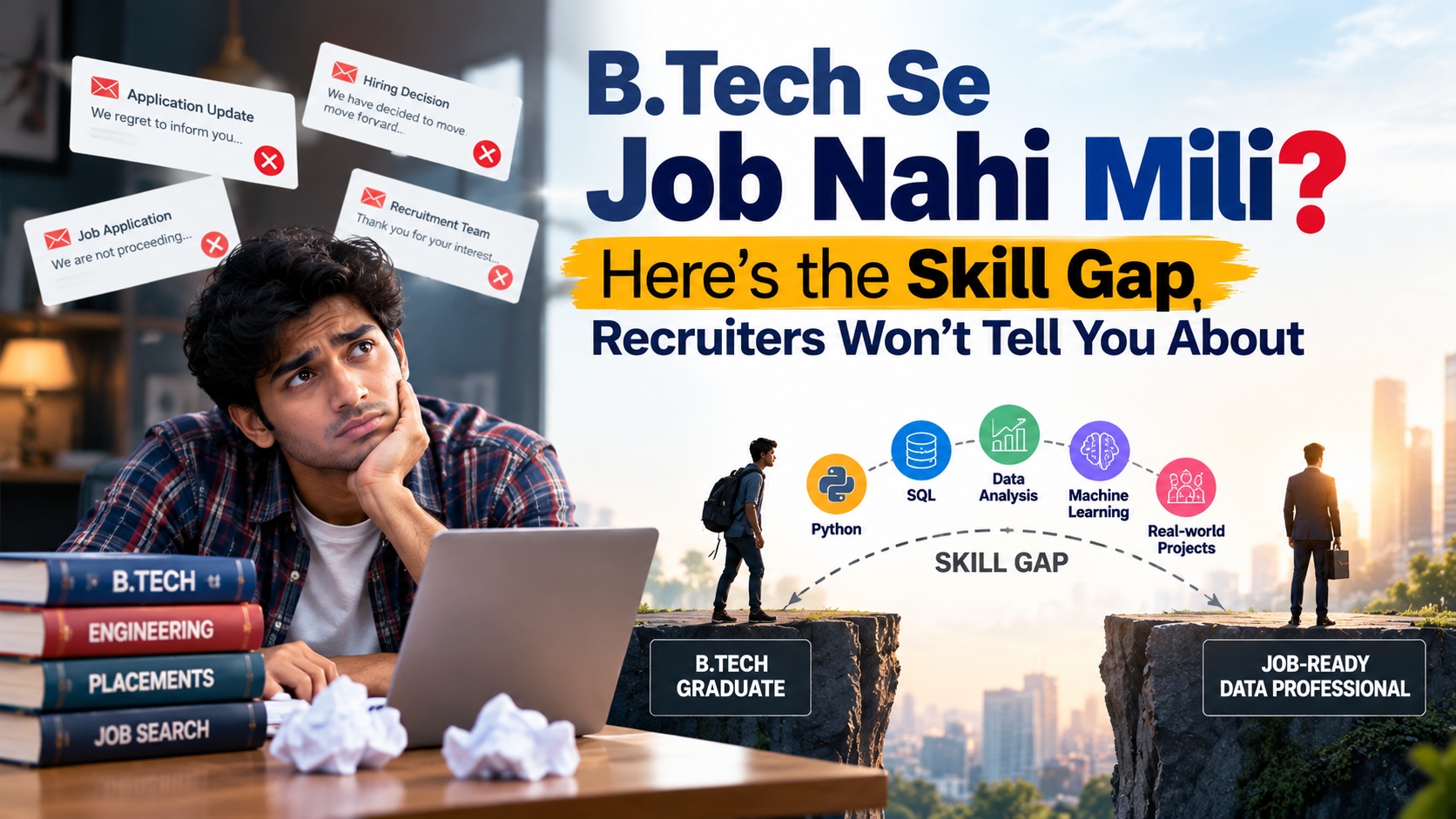
Quick, honest answer: if you’ve got a B.Tech and you’re still job hunting, it’s probably not because you’re not smart enough. It’s because your degree taught you to pass exams, and recruiters are hiring for something else entirely — the ability to actually build something, explain your thinking, and work with tools your syllabus never mentioned. That gap has a name in HR circles: the employability gap. Nobody puts it on a placement brochure, but it’s the single biggest reason a “good” CGPA isn’t converting into offers anymore.
Let’s actually unpack what’s going on, because “upskill yourself” is not useful advice on its own — you need to know what to upskill in, and why the old playbook stopped working.
Wait, Isn’t There Supposed to Be a Talent Shortage?
Here’s the part that makes this whole situation feel so unfair: you keep hearing that India desperately needs tech talent, that there’s a massive skills shortage, that companies can’t find enough people. And that’s… also true. NASSCOM’s own research, State of Data Science & AI Skills in India, projects India’s demand for data science and AI professionals will cross 1 million by 2026, with a demand-supply gap running as high as 60–73% for roles like ML engineers, data scientists, and data architects.
So how can there be a talent shortage and thousands of unemployed B.Tech graduates at the same time? Because “shortage” doesn’t mean “shortage of degree-holders.” It means a shortage of people who can do the work the moment they’re hired—and that’s a completely different bar than the one your college measured you against.
This is the paradox at the heart of the B.Tech employment crisis: there’s no shortage of engineers. There’s a shortage of job-ready engineers. And the distance between those two words — “engineer” and “job-ready” — is exactly where this article lives.
The Bar Just Moved. Twice.
Even before AI entered the picture, Indian engineering education had a well-documented problem: too many colleges, too much theory, too little hands-on work. But in the last two years, two things happened that made the gap even wider.
- First, AI ate the easy entry-level work. According to Storyboard18’s reporting, entry-level IT roles in India have already declined by 20–25%, largely because AI now handles the repetitive, rules-based tasks that used to be handed to freshers to learn on — writing boilerplate code, testing, basic data cleanup. That was the “training wheels” work. It’s mostly gone.
- Second, fresher hiring itself has gotten choosier, even where it’s growing. TeamLease EdTech’s Career Outlook Report for the second half of 2026, reported by PeopleMatters, found that overall fresher hiring intent across India actually rose to 75% for July–December 2026 — but IT-sector fresher hiring specifically fell to 76% from 81% in the first half of the year. Translation: freshers are still getting hired, just not evenly, and definitely not automatically.
Here’s the reassuring part buried in all this. PwC’s 2026 Global AI Jobs Barometer, which analysed over a billion job postings globally, found that the most AI-exposed junior roles are now seven times more likely to demand traditionally “senior” skills — judgment, communication, problem-solving — than the least AI-exposed junior roles. The jobs didn’t vanish. They got redesigned around exactly the things a purely theoretical B.Tech doesn’t teach.
So What Are Recruiters Actually Filtering For?
If your resume keeps getting filtered out at the first stage, it’s almost never because of your college name or your branch. It’s usually one (or several) of these:
- You can’t show them anything you’ve built
A CGPA tells a recruiter you can memorize and reproduce. It says nothing about whether you can take an ambiguous, messy problem and actually solve it. This is why “final year project” alone doesn’t cut it anymore if it was copy-pasted from a YouTube tutorial with the variable names changed. Recruiters can tell. They’ve seen the same tutorial project a hundred times this hiring season.
- You’ve never worked with the tools the job actually uses
Most engineering curricula are years behind industry tooling — not because professors are lazy, but because syllabi take years to update while tools change every few months. The World Economic Forum’s Future of Jobs Report 2025 found that AI and big data top the list of the fastest-growing skills employers want, globally, right now. If your curriculum hasn’t touched this, that’s not your fault — but it is your problem to solve before you apply.
- Your communication doesn’t match your marks
This one surprises people the most. Plenty of toppers freeze in interviews — not because they don’t know the answer, but because they’ve spent four years optimizing for written exams, not spoken explanations. Recruiters aren’t just checking if you know something. They’re checking if you can explain it to a teammate, a manager, or a client without thirty seconds of dead air first.
- You’re applying with a “fresher” mindset to a market that’s stopped hiring purely on potential
This is the hardest pill to swallow, but it’s the most honest one: the old deal — “hire a fresher, train them for six months, they’ll be productive eventually” — is quietly breaking down in a lot of companies, because AI tools have made “AI-augmented mid-career hire, productive in week one” a realistic alternative. That doesn’t mean freshers are unhireable. It means the freshers who do get hired are the ones who’ve already closed some of that six-month gap themselves, before the interview.
What Actually Closes the Gap
None of this means your B.Tech was wasted — it means it was only ever step one. Here’s what genuinely moves the needle, based on what’s actually showing up in hiring patterns right now:
- Two or three real, end-to-end projects you can explain in depth, including why you made the choices you made — not ten shallow ones copied from tutorials.
- Comfort using AI tools, and knowing when not to trust their output. Employers increasingly expect this by default, not as a bonus skill.
- Practising explaining your work out loud, not just writing it down. This alone fixes a huge chunk of interview failures that have nothing to do with technical ability.
- Picking a specific direction — data science, AI engineering, core software, whatever fits you — instead of vaguely “knowing a bit of everything.” Recruiters trust depth over breadth from freshers now.
Globally, graduates themselves are catching on to this shift. CFA Institute’s 2026 Graduate Outlook Survey found that 95% of graduates now see upskilling and additional qualifications as important in today’s job market — a strong signal that “the degree alone will get me there” is no longer the working assumption, even among students who are otherwise confident about their prospects.
Where to Go From Here
If you’re trying to figure out which specific direction to build toward after your B.Tech, our earlier post on Choosing Between Data Analyst and Data Science Roles: A 2025 Roadmap is a good next stop, since “pick a direction” is easier said than done without knowing what each path actually demands. If you want a more grounded sense of what that choice actually feels like day to day, Data Analyst vs Data Scientist vs AI Engineer: What They Actually walks through what each role actually looks like on an ordinary Tuesday, not just on paper.
On the “I don’t have real projects” problem specifically — since it’s the single biggest gap we see in B.Tech portfolios — our guide on Top 10 Data Science Projects That Will Get You Hired in 2026 is built exactly around the kind of project depth recruiters are now screening for.
If you’re still asking whether it’s even worth pursuing data science given how competitive things feel right now, we’ve answered that head-on in Is Data Science a Good Career for Freshers in 2026? And since a lot of this article has been about the gap between what you studied and what companies actually want, AI vs Data Science in 2026: What Companies Actually Want goes further into that exact question — useful if you’re deciding where to focus your upskilling first.
Finally, if the AI-tool-fluency gap specifically feels like your weak spot, Career Evolution in the AI Era: Why Strategic Upskilling Gets You Noticed goes deeper into closing that without needing to go back and redo your degree.
Frequently Asked Questions
- Why don’t B.Tech graduates get jobs in India despite a talent shortage?
Because the shortage is for job-ready talent, not degree-holders. NASSCOM projects India’s demand for data science and AI professionals will exceed 1 million by 2026, but that demand is for people who can contribute immediately — real project experience, tool fluency, and communication skills that most engineering curricula don’t teach directly. - What is the biggest skill gap among Indian engineering graduates?
Practical, hands-on project experience is consistently the biggest gap, closely followed by communication skills and familiarity with current AI tools. Technical theory is rarely the problem — the ability to apply it independently and explain it clearly usually is. - Is a B.Tech degree still worth it in 2026?
Yes, but it’s the foundation, not the finish line. A B.Tech gives you the fundamentals recruiters expect you to already have; it’s the additional project work, tool fluency, and communication practice layered on top that actually gets you hired. - How can a B.Tech fresher close the skill gap before applying for jobs?
Focus on two or three real, well-understood projects rather than many shallow ones, build comfort with current AI tools, and practice explaining your technical work out loud, not just on paper. A short, structured, project-heavy course can compress months of self-guided trial and error into a few focused weeks. - Do recruiters care more about CGPA or projects?
Increasingly, projects and demonstrated skills matter more than CGPA alone. A strong CGPA can open the door to a first screening, but it rarely survives a technical round or interview without real project depth behind it. - Is AI making it harder for B.Tech graduates to get jobs?
It’s changing what “entry-level” means rather than eliminating entry-level jobs outright. AI has automated a lot of the repetitive work freshers used to be hired to learn on, so companies now expect junior candidates to add value sooner — but PwC’s research shows this is shifting demand toward human judgment and communication skills, not just erasing junior roles.