

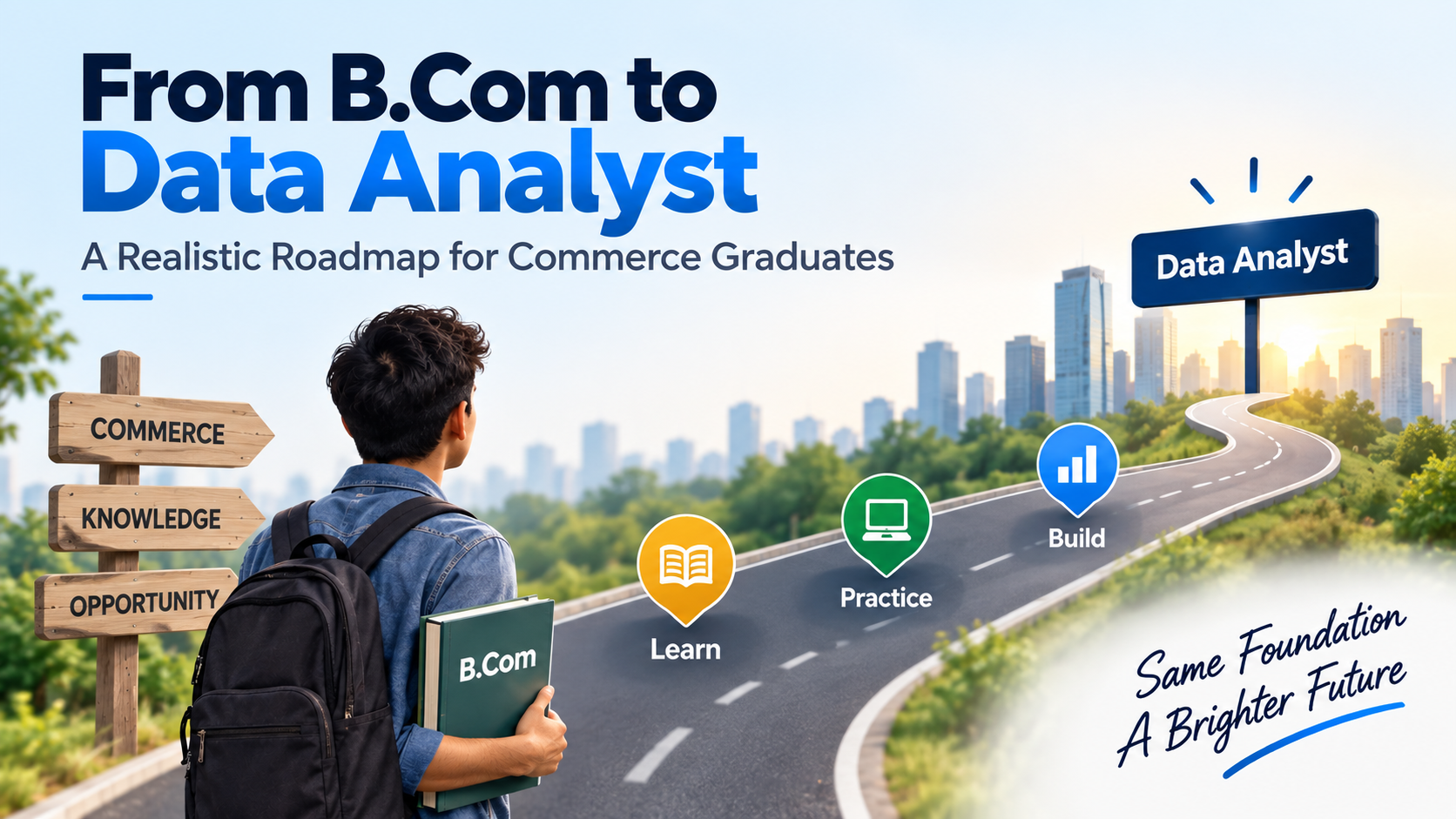
Short answer first: yes, a B.Com graduate can become a data analyst, and honestly, it’s one of the more realistic tech-adjacent career switches out there. No engineering degree, no years of catching up on code. What you actually need is a clear plan, because “learn Excel and SQL” isn’t a strategy on its own — it’s just a to-do list with no order to it. And it’s not even the full list anymore, which is exactly what we’ll get into. So let’s put it in order, and let’s do it with 2026’s job market in mind, not the one from five years ago.
Here’s the thing worth saying upfront: your commerce degree isn’t something you’re overcoming. You already think in terms of revenue, margins, and what a number means for a decision — that’s a real head start most people don’t give themselves credit for. The technical side — SQL, dashboards, and yes, some Python and AI familiarity now — is genuinely learnable once you know what to build toward.
Why Data Analyst Is the Smart First Move
A lot of commerce graduates aim straight for “data scientist” because it’s the flashier title. In practice, data analyst is usually the better first target — not a smaller goal, just a smarter entry point.
The real difference isn’t “analyst doesn’t need to code, scientist does.” It’s depth. A data scientist is expected to build and tune models from scratch — deep statistics, feature engineering, model architecture. A data analyst is expected to understand how those models work, use basic Python to speed up their own analysis, and know enough about AI tools to use them well — without needing to build a model from the ground up. That’s a real difference in depth, not a difference in whether code and AI show up in your day at all. A lot of experienced data scientists in India didn’t start there, either — they started as analysts and grew into the deeper technical side once they had real data experience behind them. Starting as an analyst isn’t the slow route. For a commerce graduate, it’s usually the fast one.
Why “Just Excel and SQL” Doesn’t Cut It Anymore
This is worth being upfront about, because a lot of career advice hasn’t caught up to it: the data analyst job description of 2026 doesn’t look like the one from 2020. Open ten analyst listings on LinkedIn or Naukri right now, and a solid chunk of them will ask for basic Python alongside Excel and SQL — not to build machine learning models, but to automate reporting, work with larger datasets, and use AI tools competently. A growing number also expect at least a working understanding of how ML models work, even if you’ll never build one yourself, because analysts are increasingly the ones interpreting model outputs for the business, not just building dashboards from raw numbers.
None of this means an analyst role has quietly become a data scientist role. It means the line between “analyst” and “scientist” has gotten blurrier at the edges, and the analysts getting hired are the ones who can sit comfortably on both sides of it — strong with dashboards and stakeholder communication, but not lost the moment Python or a model output shows up in the conversation.
What AI Has Actually Changed for This Role
Worth addressing head-on, because it’s probably crossed your mind: doesn’t AI just do this job now?
Not really — but the role has shifted, and it’s worth understanding how. AI tools now handle a lot of the repetitive stuff — first-draft summaries, quick charts, routine data cleanup. That part’s real. What hasn’t gone anywhere is the judgment call underneath it all: knowing which question to actually ask the data, catching when a number looks off, explaining what a trend means for the business. AI can build you a chart in seconds. It’s a lot worse at telling you why the chart matters — or at knowing when its own output is wrong.
This tracks with what’s happening on the demand side too. NASSCOM’s own research, State of Data Science & AI Skills in India, expects India’s demand for data science and AI-adjacent talent to cross 1 million by 2026, with a persistent gap across the wider data pipeline — not just at the data scientist level. And the World Economic Forum’s Future of Jobs Report 2025 found analytical thinking is still the single most in-demand core skill globally — something AI assists with, but doesn’t replace.
On the earning side, this path holds up too — it’s not a consolation prize. Glassdoor’s India data puts the average data analyst salary at ₹7 LPA, with a realistic range of ₹4.95–11.5 LPA depending on experience and city, and that climbs further once you add AI and applied ML fluency on top of the core analyst skill set.
Bottom line: the analysts getting hired right now are the ones using AI and basic ML understanding to work smarter, not the ones who stopped at dashboards and hoped that would be enough.
Data Brio Academy’s Suggested Roadmap
Quick note before this: the pacing below isn’t a claim about how it works everywhere — it’s the structure we actually use at Data Brio Academy when we take commerce graduates through this transition. Your own timeline will move faster or slower depending on how many hours a week you can put in, but this is a realistic shape to work from.
Phase 1: Foundations (Roughly Weeks 1–8)
- Excel, properly. Pivot tables, VLOOKUP/XLOOKUP, cleaning up messy data — you probably already have a head start here from accounting and finance coursework.
- SQL basics. This is the one skill that pays off fastest. It’s how you’ll actually pull and shape data on the job, and it reads more like structured logic than “real coding.”
- Statistics you can use, not just recall. Mean, median, correlation, spotting when a number’s misleading. A good chunk of this overlaps with commerce math you’ve already done.
Don’t try to “finish” any of these before moving on — learn just enough, then go use it. That’s what actually makes it stick.
Phase 2: Dashboards and Applied Analysis (Roughly Weeks 9–16)
- Power BI or Tableau. Usually the fastest visible win for commerce grads, since presenting numbers clearly is a skill you’re likely already halfway good at.
- Basic Python, beyond just knowing what it is — enough to clean and explore data without relying on Excel for everything.
- Your first real project, ideally in something you already understand — sales trends, customer retention, budget variance. This is where the commerce background stops being a footnote and starts doing actual work for you.
Pick a project in a business area you get. Someone who can explain a churn dashboard with real business reasoning will beat someone with a technically cleaner dashboard they can’t talk through.
Phase 3: Applied AI, ML Fundamentals, and Portfolio (Roughly Weeks 17–24)
- Working familiarity with ML concepts. You’re learning what a prediction model actually does, how to read its output, and where it can mislead you if you take it at face value.
- AI-tool fluency for real work, not just chatting with a model — using AI to speed up first-pass analysis while knowing when to double-check it. This has moved from “nice to have” to close to a baseline expectation in current job listings.
- Two or three deep, well-understood projects — not ten shallow ones. Ideally, at least one shows you working with Python and a basic model, not just a dashboard.
- Practice explaining your work out loud. This is where a lot of career-switchers lose ground, regardless of how good the technical work actually is.
Depth beats volume every time here. Recruiters can tell the difference between a tutorial project and one you actually thought through — and increasingly, they’re looking for at least one project that shows you’re comfortable past the dashboard layer.
What This Looked Like for Real Commerce Graduates
“The course has the right balance between theory and practical which is so valuable for understanding. This course provided me exposure to real-time projects and also gave me the first job in my data science career.”
– Souvik Saha (B. Com graduate), now senior data analyst, UST Global
“The learning experience at Data Brio Academy was transformative! I came from a non-technical commerce educational background. The live sessions, hands-on projects, and constant mentor support helped me gain confidence in Data Science and Python. The capstone project and internship gave me exactly the kind of real-world exposure I needed. I’m truly grateful to the mentors who made complex topics feel so simple.”
— Yashaswini Borar (B.Com graduate), now Senior Data Analyst at Business Brio
Where to Go From Here
If you eventually want to grow from analyst into something more technical, that’s a common next step once you’ve got real analyst experience behind you — our post on Choosing Between Data Analyst and Data Science Roles: A 2025 Roadmap lays out how that move tends to happen.
Stuck on what to actually build for your portfolio? Our guide on Top 10 Data Science Projects That Will Get You Hired in 2026 has ideas that work well for analysts too, not just the more advanced tracks.
Still weighing whether this is worth it given how much AI is shaking up hiring? We’ve tackled that directly in Is Data Science a Good Career for Freshers in 2026?
And if AI-tool fluency and applied ML specifically feel like your gap, Career Evolution in the AI Era: Why Strategic Upskilling Gets You Noticed goes deeper into closing that without a computer science degree behind you.
Frequently Asked Questions
- Can a commerce (B.Com) graduate become a data analyst?
Yes — it’s one of the more accessible tech-adjacent switches for commerce graduates. The role leans on business context and structured thinking, which a commerce background already builds, layered with learnable technical skills like SQL, Excel, dashboarding tools, basic Python, and working familiarity with ML and AI. - Is data analyst a good starting point, or should I aim straight for data scientist?
Data analyst is usually the smarter first move for commerce graduates — lower entry barrier, higher hiring volume, and a lot of experienced data scientists started here anyway. It’s the faster way in, not a smaller goal, and the skills you build carry forward if you decide to go deeper later. - How long does it take a B.Com graduate to become job-ready as a data analyst?
Most structured, project-based paths run somewhere between 6 and 7 months, depending on how much time you can put in weekly — that now includes basic Python and applied AI/ML familiarity, not just dashboards and SQL. Self-taught, unstructured learning usually takes longer, mostly from time lost figuring out what to learn next. - Will AI replace data analyst jobs?
It’s reshaping the role more than replacing it. AI now handles a lot of the repetitive work — first drafts, basic charts — but the judgment part, knowing what questions to ask and what a trend actually means, is still firmly human. Analysts who know how to work with AI and understand basic ML concepts tend to become more valuable, not less. - Do I need to learn Python to become a data analyst?
Yes, at least at a basic level. It’s no longer an optional “nice to have” for later — a growing share of current data analyst job descriptions expect basic Python alongside Excel and SQL, mainly for automating analysis and working with AI tools effectively. You don’t need software-engineer-level Python, but skipping it entirely will narrow your options.