

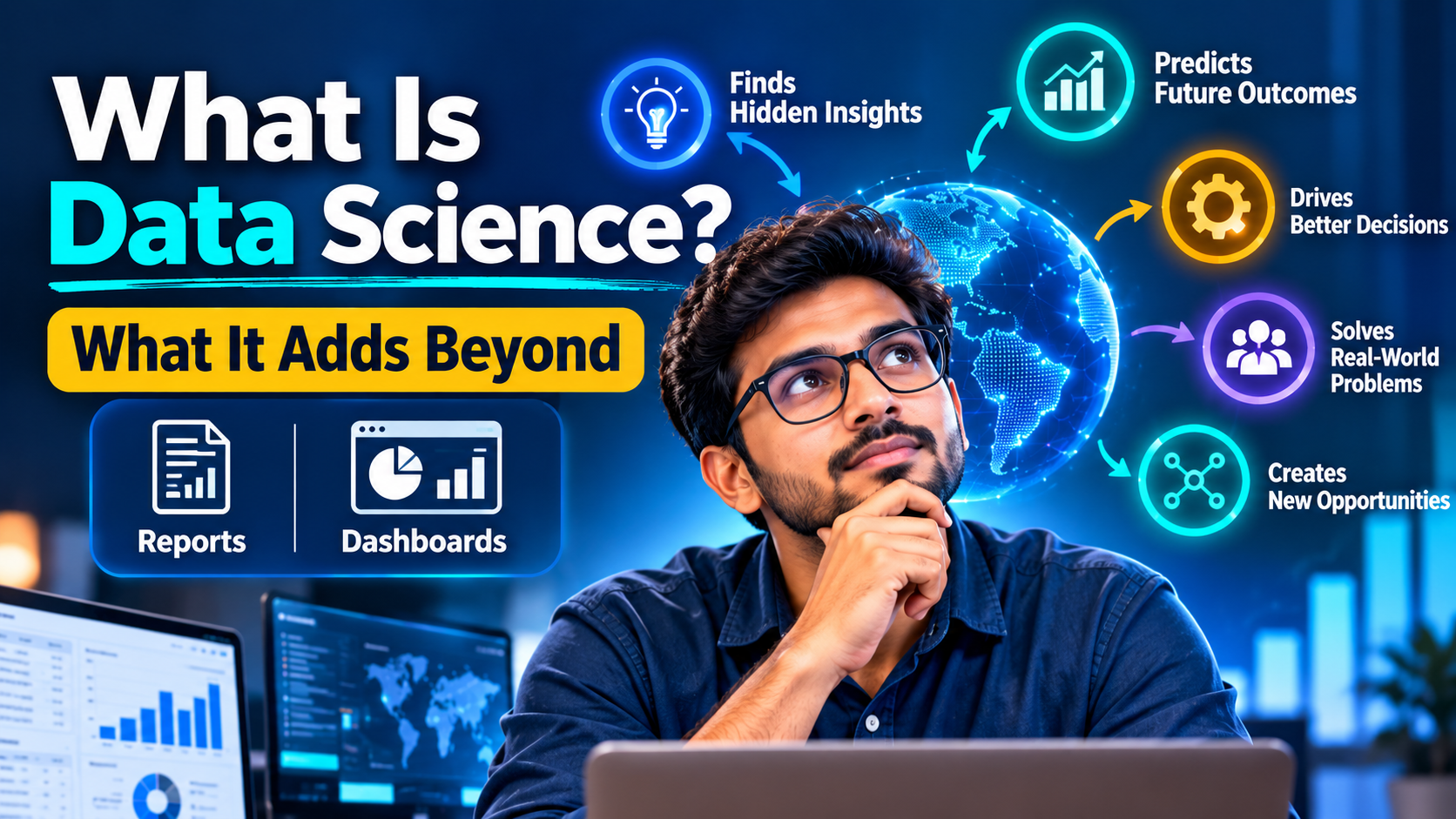
Reports and dashboards are useful because they show what has happened. But a business may need to ask what is likely to happen next, which outcomes may be more likely, whether difficult patterns can be identified, or whether a proposed change makes a measurable difference.
Consider a subscription business where cancellations are increasing. A dashboard can show the trend. The next question may be: which customers are more likely to cancel?
That changes the analytical task. Prediction can provide an estimate of which outcomes may be more likely next. The estimate is not a certainty; it needs to be validated and connected to an appropriate business action.
Data Science can add several kinds of analytical work beyond conventional reporting:
- Prediction
When there is a future outcome worth estimating and enough relevant data, statistical and machine-learning methods can be used to estimate likely outcomes.
- Machine-learning-based analysis
Some patterns in customer behaviour can be difficult to see in conventional summary reporting. Machine-learning methods can help identify patterns for tasks such as prediction or classification.
- Experimentation and test design
When a business proposes a change, structured test design can help compare groups or scenarios and assess whether the proposed change makes a measurable difference.
How Data Science relates to Analytics, Machine Learning and AI
Analytics involves extracting insight from data to understand performance, patterns and business questions. Machine Learning refers to methods that learn patterns from data for tasks such as prediction or classification. Artificial Intelligence is a broader field that includes areas such as perception, reasoning, learning and generation.
Data Science brings together statistical reasoning, data preparation, programming, analytical methods and, where appropriate, machine learning to address data-driven questions.
A Data Scientist’s contribution is not simply choosing an algorithm. It can involve understanding the business question, identifying and preparing relevant data, selecting an appropriate method, analysing or modelling the data, validating the result, interpreting it, communicating it and connecting the result to an action or decision.
Does every business problem need Data Science?
No. A report or dashboard may be exactly what a business needs when the main requirement is to understand current or historical performance. Data Science becomes relevant when the question requires prediction, complex pattern analysis using machine learning, or structured experimentation.
A practical way to distinguish the questions is:
Reporting: What happened?
Analysis: What can we learn?
Prediction: What might happen next?
Experimentation: Does a proposed change make a measurable difference?
The useful principle is simple: the method should follow the question. Data Science is valuable when the business question requires the kinds of analysis that it can provide; it is not something every problem automatically needs.